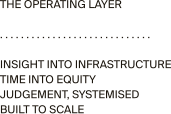
Every other venture studio builds on conventional infrastructure. We build on an operating system designed for the next economy — the substrate that makes generationally advantaged company-building possible.
The conventional venture studio is an excellent invention. It assembles founders, provides initial capital, supplies operational support, and helps new companies through their earliest stages. We respect the form. We also believe it has reached its limit.
The conventional studio still builds on conventional infrastructure. Codebases written from scratch. Sales pipelines built from zero. Marketing functions hired in. Administrative overhead absorbed. Coordination cost rebuilt company by company by company. Even the best conventional studios produce companies that look structurally similar to the companies that came before them — smaller, faster, better-funded, but architecturally the same.
This is not what the agentic economy will reward.
Techne Ventures builds on Decidr OS. Decidr is a goal-driven, marketplace-native, automation-powered operating system for agentic organisations. It provides the schema, the cell-driven data architecture, the projection engine, the task type marketplace infrastructure, the decision support models, the evaluation systems, and the automation runtime as a substrate, not as features to be built.
When a Techne Ventures company starts, it does not start at zero. It starts with the operating substrate already in place. The schema is already there. The marketplace is already there. The automation is already there. The codification methodology is already there. What the founder brings is the craft, the customer insight, the specialised knowledge, the strategic positioning — the things that matter and that no substrate can replace.
The companies we build operate with structurally different unit economics from companies built on conventional infrastructure. Their cost of customer acquisition is different because they enter marketplaces with built-in matching. Their cost of administration is different because flow runs are order line items. Their cost of growth is different because automation is the operating layer, not an aspiration. Their cost of trust is different because evaluation is continuous and published.
This is the substrate thesis. Build on the right substrate and the company-building advantage compounds. Build on the wrong substrate and the company is structurally disadvantaged before it has hired its first employee.
Techne Ventures is the studio that builds on the right substrate.
For most of the twentieth century, the value of a firm was largely the value of the people inside it carrying tacit knowledge in their heads, coordinated through management hierarchies. The firm was a structure for assembling, retaining, and orchestrating human cognition at scale.
This worked. It worked extraordinarily well for a century. It produced the modern economy. It is not what the next decade will reward.
Schema-driven AI is doing to knowledge work what mass manufacturing did to industrial production. It is industrialising the substrate. The same way that machine tools, standardised parts, assembly lines, and process engineering allowed industrial output to scale at a quality and cost trajectory that no artisanal producer could match, the combination of structured schema, agentic apps, codified task types, and goal-driven automation is allowing organisational output to scale at a quality and cost trajectory that no traditionally-structured firm can match.
The administrative layer becomes an app install. The sales function becomes a marketplace match. The marketing function becomes a podium position. The coordination layer becomes automated flow runs. The reporting layer becomes continuous evaluation. The compliance layer becomes structured attribute validation. None of these are aspirational descriptions of distant futures. All of them are what the Decidr OS does, today, as substrate.
What remains for humans inside this new structure is the part that matters most: the craft, the judgement, the values, the strategic vision, the relationship work that genuinely requires presence, and the deep specialisation that compounds with practice. The agentic substrate does not diminish the human. It returns the human to the work that only the human can do.
But it also unambiguously diminishes the firm that exists primarily to coordinate, administer, and orchestrate human labour. That firm is being unbundled by the substrate. Its functions are becoming installable. Its overhead is becoming optional. Its competitive advantages are becoming portable to anyone with access to the right OS.
We believe the next ten years will produce the largest restructuring of the firm since the industrial revolution. Techne Ventures exists to build the companies that exist on the new substrate, before the cost of doing so has been priced in.
We build three kinds of companies, structured around three kinds of opportunities the agentic economy creates. Each is distinct in origination, partnership, and outcome. Each is built on the same Decidr OS substrate, with the same studio capability, and the same long-horizon view of value.
New companies started from inception inside the Decidr ecosystem. Fully agentic-native, codified from day one, with no legacy operating model to unwind. Partnered with excellent professionals or originated against internal Ventures theses.
Partnerships with existing businesses to build agentic-native parallel organisations on the Decidr OS. The existing business continues. The new agentic org operates alongside. The two coexist, just as offline and online commerce coexisted for decades.
Ventures originated to create entirely new markets or render existing ones obsolete through Decidr-native operating advantages, structural efficiency, and unfair scale. Designed not to compete in existing categories but to make them irrelevant.
The cleanest expression of the Techne Ventures model is the greenfield build. A new company, founded inside the Decidr ecosystem, with codified craft at its core, agentic-native operating architecture from day one, and no legacy structure to unwind.
These ventures typically begin in one of two ways.
The first is a partnership with an excellent professional — the senior partner, master practitioner, or domain expert whose craft, codified into typed task type vendor apps and deployed inside agentic marketplaces, would create category-defining value. The founder brings the craft. Techne Ventures brings the operating substrate, the studio team, the codification methodology, and the capital relationship with Techne Capital. The new venture is the vehicle.
The second is an internal thesis developed within the studio — a market position, customer segment, or category opportunity that Techne Ventures identifies as structurally valuable and originates as a build. We then recruit the founder, assemble the team, and stand the company up against the thesis.
In both cases, the new company starts agentic-native. It does not have a sales pipeline because it has a marketplace position. It does not have a marketing budget because it has demonstrated performance on the podium. It does not have administrative overhead because flow runs are order line items. It does not have a coordination tax because the projection architecture is the coordination layer.
The second build mode is the one most large existing businesses need but cannot construct alone. We call it the joint venture parallel agentic org.
Here is the situation it solves. An established business sees the agentic opportunity clearly. The leadership understands the substrate shift. They recognise that the existing business has a structural ceiling that an agentic-native extension would lift dramatically. But they cannot put the existing business at risk to build the new one. The board will not approve it. The cash flow will not absorb it. The talent required will not join the existing firm structure. Every internal pathway is blocked by legitimate constraints.
The joint venture parallel agentic org resolves this. Techne Ventures, in partnership with the existing business, stands up a new, separately-governed, agentic-native company on the Decidr OS. The new entity has its own equity structure, its own talent, its own operating culture, its own marketplace position, and its own growth trajectory. The existing business contributes customer relationships, category credibility, brand equity, operating knowledge, and strategic patience. Techne Ventures contributes the studio team, the substrate, the build capability, and the partnership with Techne Capital that absorbs the venture risk externally.
The historical analogue is exact. When online commerce arrived, the businesses that survived best were not the ones that abandoned their physical operations and bet everything on the new channel, nor the ones that ignored the new channel and stayed purely offline. They were the ones that built parallel online entities, learned in both worlds simultaneously, transitioned capability and customer relationships at whatever pace was practical, and ultimately operated successfully in both forms for as long as both forms made commercial sense.
We believe the same pattern applies now. Over time, capability flows from the legacy entity into the agentic entity. The agentic entity grows. The legacy entity continues to serve the customers and capabilities that legitimately remain in the traditional form. Both win. The shareholders of the existing business gain equity in both entities. The new entity gains a generational head start.
The third build mode is the most ambitious. These are ventures originated not to compete in existing markets but to render them irrelevant — or to create entirely new markets that did not previously exist at any scale.
The agentic substrate makes a category of business possible that was previously unbuildable. When the cost of administration, sales overhead, coordination, and quality assurance falls by an order of magnitude through structural agentic operation; when distribution becomes marketplace-native rather than salesforce-dependent; when specialisation can be codified, distributed, and scaled across thousands of task type runs without quality decay; when evaluation is continuous and provenance is structural — the unit economics of entirely new business models become viable.
We are interested in ventures that exploit this directly. Not as faster, cheaper, or better-funded versions of existing companies, but as structurally different organisms that do something the incumbents cannot do at any price.
Examples of the patterns we look for: professional services categories where the entire firm structure is replaced by a marketplace of codified specialists with measurable performance; advisory, analysis, and decision support categories where the human consultant is replaced by structured DCM-driven specialist apps competing on demonstrated outcomes; knowledge work categories where the unbundling of tacit-knowledge-dependent firms creates space for codified-specialist-led marketplace entrants; entirely new market categories where the Decidr OS makes intelligible and addressable a customer demand that previously could not be served at viable economics.
These ventures are difficult to build. They require deep conviction, strategic patience, the willingness to challenge category orthodoxy, and a founding team capable of operating at the intersection of substrate advantage and category creation. They are also the ventures that produce category-defining outcomes.
Traditional markets are forgiving to latecomers in ways that agentic markets will not be. In traditional markets, a well-capitalised entrant can buy distribution, hire away talent, acquire competitors, and effectively backfill the time advantage of incumbents. Money buys speed. Late entry is recoverable.
Agentic marketplaces work differently. They are structurally merit-based. Performance is published. Provenance is tracked. Podium position is earned through demonstrated outcomes across thousands of task type runs. The Decision Choice Score is computed against transparent attribute structures. The customer’s SMARTeR goals are matched to the specialist’s actual track record, not to the specialist’s marketing claim.
In this structure, the early high-quality entrant accumulates an advantage that compounds in a way late entrants cannot replicate.
The early specialist publishes a task type. The task type runs ten thousand times. Each run improves the evaluation score, deepens the provenance, refines the underlying codification, and strengthens the podium position. By the time a latecomer publishes a competing task type, they are not entering a level playing field. They are entering a market where another vendor has ten thousand documented runs of provenance, an established quality history, a refined product, and customer goal architectures already wired to their podium position.
This is the land grab. It is not a marketing metaphor. It is a structural feature of how agentic marketplaces reward early high-quality entry.
We believe the next three to five years will determine the long-run podium structures of many task type markets that will be enormous by the end of the decade. The businesses that embed early, with real craft, real codification, and real customer outcomes, will accumulate provenance advantages that no amount of later capital can buy.
We are building, now, against the markets that will matter in 2030. Not because we expect them to be large then. Because we believe the businesses that will own them are the ones being founded now, on the right substrate, by the right specialists, with the right partnership structure.
Techne Ventures operates as a venture studio with five distinguishing characteristics. Each is structural. Each is operational. Each is part of why we believe the studio model, built on the Decidr substrate, produces companies that traditional studios cannot match.
Decidr OS is not a future capability. It is the substrate the studio builds on today. New ventures begin with the schema, the marketplace, the projection architecture, the automation runtime, the codification methodology, and the agentic operating layer already in place. The studio is constructed around the substrate, not bolted on top of it.
The studio team is staffed with engineers, designers, schema architects, codification specialists, and operating partners who have built repeatedly on the Decidr OS. They are not generalists transferring from conventional venture studios. They are specialists in agentic-native company-building, with the methodology, tools, and shared vocabulary that makes that work fast.
Capital risk is structured externally to the founder and to the studio. Techne Capital, as our sibling allocator, may provide founding capital, follow-on capital, or co-investment alongside other LPs. The capital structure is designed to remove personal financial risk from founders and balance sheet exposure from existing-business partners, on terms that preserve real alignment.
Founders earn meaningful equity. Excellent professionals partnered with the studio earn meaningful equity. Existing-business partners in joint venture parallel agentic orgs earn meaningful equity. The studio earns equity for the substrate, the build, and the operating capability it contributes. No party is treated as a service provider. Everyone is a partner in the long-run outcome.
We hold long. We support portfolio companies through years, not quarters. We measure success in compounded provenance, marketplace position, and craft depth — not in funding round velocity. We build companies designed to be valuable in 2035, not companies designed to look valuable in 2026.
Decidr, Techne Ventures, and Techne Capital share a worldview. They share an ecosystem. They frequently work together. They are not the same business, and we are unambiguous about this. The alignment is structural, not promotional.
The operating system substrate. The schema, the cell-driven architecture, the projection engine, the task type marketplace infrastructure, the decision support models, and the agentic runtime. A generational platform on which the agentic economy is being built. Independent of Techne Ventures. Operates under its own governance and ownership structure.
The venture studio that builds new companies on the Decidr substrate. Originates ventures, partners with excellent professionals and existing businesses, runs the studio team that constructs the agentic-native operating architecture, and shepherds new companies through their earliest stages to independence. Independent of Decidr and Techne Capital.
The capital allocator. Deploys patient capital into businesses aligned with the agentic economy thesis — including, but not limited to, Techne Ventures-originated companies. Removes investment risk for excellent professionals and existing businesses entering the agentic economy. Independent LP base, fund structure, and investment governance.
Senior specialists, master practitioners, and domain experts ready to codify decades of craft into a new agentic-native venture. We provide the substrate, the team, the methodology, and the capital relationship. You bring the craft and the conviction.
Begin the conversation →Established profitable businesses ready to stand up a parallel agentic-native organisation alongside the legacy operation. External capital. Separate governance. Shared upside. Live in both worlds at whatever pace is practical.
Begin the conversation →Founders with category-creation ambition. Strategic thinkers who see existing industries clearly enough to know which can be made obsolete. We originate market-creating ventures rarely — and when we do, we go deep.
Begin the conversation →